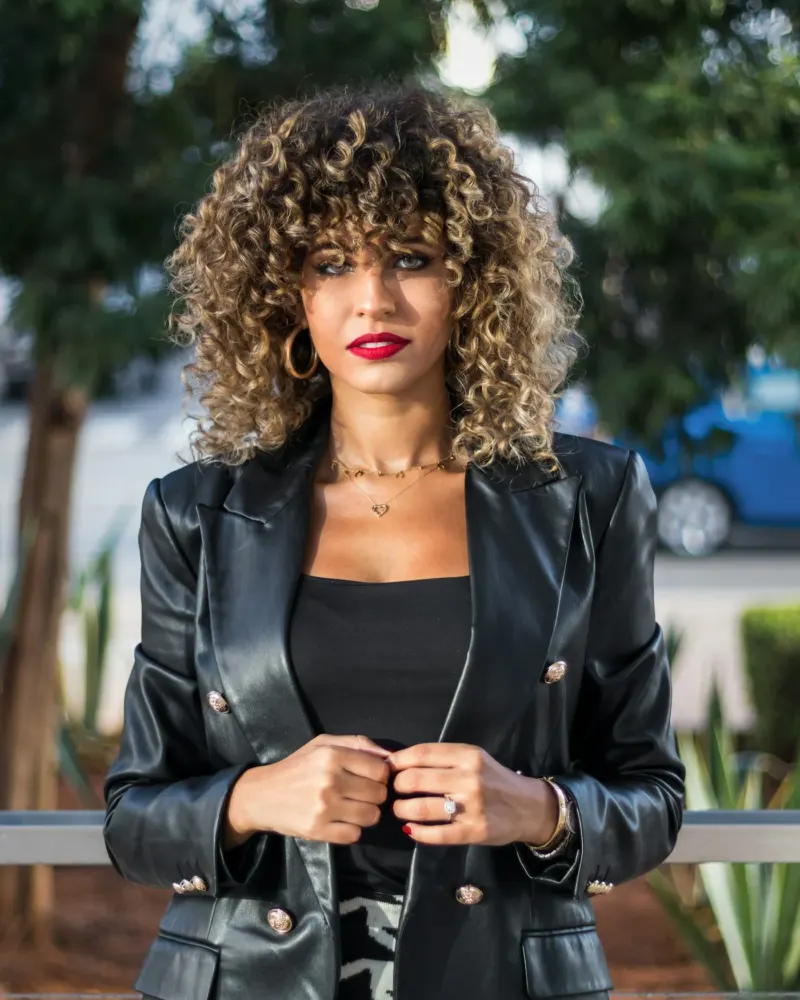
Photo: Othman El Marzak / Unsplash.
A different part, a loose pin, or a small section pulled back can change the feel of your hair without changing its natural texture.
In this story Jump to a section +
These are styling ideas rather than a universal curl routine. Curl patterns, density, length, and personal preferences vary, so begin with what already feels comfortable for your hair. Use clean accessories that hold without snagging, and stop or loosen a style if it pulls at your scalp. You do not need a perfectly defined curl pattern for any of these looks.
1. A softly pinned side
Choose the side you naturally like to sweep back. Take a small section near the temple, guide it toward the back of your head, and secure it with one or two pins. Keep the section loose enough that it does not pull the hairline. Rather than brushing the whole style smooth, arrange the visible curls with your fingers.
This is a useful option when you want your hair out of your face while leaving most of its volume intact. If pins slide, try crossing two in a small X or choose an accessory with a shape that suits your density. Avoid forcing a small pin to hold a section that is too thick.
2. Half-up, with room for texture
Gather a small upper section from above the ears and secure it with a soft tie or a clip. Start with less hair than you think you need; you can add more if it feels balanced. Let the lower section fall naturally, and loosen the crown a little if you prefer a softer shape.
For shorter hair, make the upper section smaller or pin back two sections instead of joining them. For longer hair, a loose twist may help contain the ends. A style that stays comfortable through the day is more useful than a very tight version that only holds for a photograph.
3. A low, loose ponytail
Guide the hair toward the nape with your hands, keeping the sides as textured as you like. Secure it with a soft tie. Then check the tension by gently moving your head and touching the hair around the tie. If it feels tight, remove the tie and start again with a little more room.
A few face-framing curls can make the shape feel relaxed, but they are optional. You can also shift the ponytail slightly to one side or wrap a fabric scarf around the tie. Keep any scarf knot away from a place where it presses uncomfortably against your neck.
4. A clip-up shape that fits your length
Gather the hair loosely, fold or twist it upward, and secure it with a claw clip large enough to close without forcing it. Let the ends sit above the clip or tuck them in gently, depending on the length. Check that the teeth are not pressing into your scalp.
Dense or long hair may need a larger clip or two smaller sections secured separately. Shorter curls can be pinned into a similar shape with several small clips. Do not keep tightening the twist to make an undersized accessory work.
5. Your usual style, with a different part
A modest shift in the part can be enough when you do not want an updo. Use your fingers to move a few curls across the top, then let them settle before deciding whether to move more. Avoid repeatedly separating a curl if you want to preserve its existing shape.
If one side looks flatter, try tucking it behind the ear and leaving the other side loose. A simple earring can become the finishing detail. This is an easy approach for a last-minute change because it needs very little equipment.
Put together a small styling kit
A few comfortable ties, pins with smooth ends, and a clip suited to your hair are a good starting point. Keep them in the place where you get ready. You may find that the right-sized accessory makes more difference than adding another product.
Photograph a style you enjoy from the front and back so it is easier to repeat. If you are trying a new product, follow its instructions and introduce it separately from a completely new routine. For persistent scalp discomfort or hair concerns, a qualified professional can give advice specific to you.
For an outfit that leaves the focus on your hair and accessories, try a simple combination from our capsule wardrobe guide.
Have a question or spot a detail we should correct? Contact the editor. Back to the beginning ↑
Illustrative stock photography by Othman El Marzak on Unsplash, used under the Unsplash License. Read our editorial policy.